

World Bicycle Day: 7 top European destinations best explored on two wheels
Whether you’re a beginner or a pro, cycling around these places is a breeze.
While there’s no denying that certain countries like the Netherlands are miles ahead when it comes to cycling infrastructure, plenty of destinations are catching on that making a city bike-friendly makes it people-friendly, and all around more attractive to visitors (and residents).
This World Bicycle Day, we thought it was time to highlight some brilliant European destinations that are best explored on two wheels. Whether you’re a total beginner or were screaming ‘look mum no hands!’ at a young age, you’ll be totally at ease in these countries and cities.
Antwerp, Belgium

London may have its Boris Bikes, and New York has its Citi Bikes, but in Antwerp, it’s all about Velo. The iconic red bikes first made their way onto streets in 2011, and tourists and residents alike use them to whizz around the city for less. In fact, 34% of commuters in the city cycle or walk to work.
The addition of bicycle streets in 2020, where cyclists have priority, has taken cycling to the next level, and Antwerp was even named the eight most bicycle-friendly city in the world by the Copenhagenize Index in 2025. You can find a selection of routes taking in the main sights on the Visit Antwerp website, but you can also use the Smart Ways to Antwerp website to plan your route, with the ability to filter by shortest route, the smoothest route (which follows the city and provinces’ cycle network as much as possible), the most comfortable route (which avoids cobblestones and unpaved bike paths), and the junction route (which takes you along the nicest cycle paths).
Read next: Short break: Antwerp and Doel, Belgium
Copenhagen, Denmark
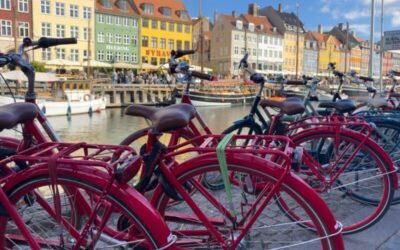
Long seen as the benchmark for cycle-friendly cities, Copenhagen has led the field for decades, shaping how the world thinks about bicycle infrastructure. With its 397 km network of bike paths and deeply embedded cycling culture, bikes are a way of life in Copenhagen. This is reflected in its curb-separated bicycle tracks, bike bridges spanning canals, cycle superhighways, traffic lights and green waves for two-wheeled travellers. Cycling accounts for 45% of all trips to work and study in Copenhagen, and Copenhageners own over 744,500 bicycles, five times greater than the number of cars.
Head out on the 69.2 km Allerød and Farum Route to explore the countryside north of the city, looping around lakes and through forested areas. For an in-town route, pedal along the Harbour Circle (Havneringen), a 13km ride around Copenhagen’s harbour, crossing bridges, gliding over the ‘Cycle Snake’ (Cykelslangen), an orange-topped elevated cycleway, and past key landmarks including the Opera House and the Black Diamond Library.
Read next: An urban guide to Copenhagen, the UNESCO World Capital of Architecture
Utrecht, Netherlands
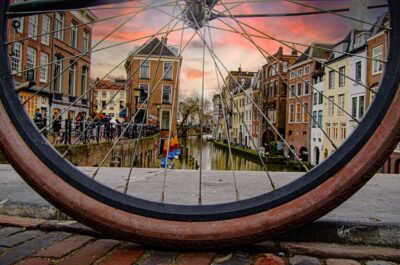
The Dutch city of Utrecht claimed the top spot in 2025 as the most cycle-friendly city on the Copenhagenize Index. Nearly one-third of all trips made in Utrecht are on two wheels, and the city boasts a huge 240 km of dedicated bike paths. Residents and visitors can use a wide array of public bike services, yet the OV-Fiets public bike scheme offers an annual rental service, ideal for locals and repeat visitors.
Either explore the city itself by bike or enjoy cycling routes in the environs. Pedal round the 59km Utrechtse Heuvelrug National Park Loop, through heathlands and forests, or for those seeking a shorter cycling adventure, take the Blossom Bike Route. Starting just southeast of the city centre and looping through areas like Wijk bij Duurstede, Bunnik, and Odijk, this route takes visitors on a 39 km path along fruit tree orchards, villages and estates in the province of Utrecht. The 51km Kromme Rijn Castles Tour is also popular with domestic travellers.
Read next: Slow city breaks: See more of the Netherlands with our guide to going beyond the icons
Valencia, Spain

Valencia, thanks to its flatness and 200 km of cycle paths, is the kind of city that could convert even the biggest cycling sceptic. Don’t believe us? Our very own Regional Editor Laura Field wrote this after a visit in 2024: “My least favourite way of exploring a city? Until January, I’d have told you it was cycling. Then I visited Valencia. When I found myself pedalling through the centre and not actively disliking it, I knew there had to be something special about this city.”
One of Valencia’s bikeable highlights is the Jardín del Turia (Turia Gardens), a nine-kilometre green corridor that winds through the heart of the city along the former course of the River Turia. With dedicated cycle paths linking parks, sports pitches and cultural attractions like the City of Arts and Science, it’s one of the easiest and most enjoyable ways to experience Valencia on two wheels.
The Spanish city, like Antwerp, has its own public bike hire scheme, Valenbisi, with more than 300 stations dotted around. Simply unlock a bike and explore. You can find several routes taking in the sights on the Visit Valencia website, or book on for a guided tour with an expert.
Read next: A sustainable city escape to Valencia, the European Green Capital for 2024
Slovenia

One thing that struck us about visiting Slovenia’s capital Ljubljana is just how alive it felt. Its city centre has been given back to people, having been pedestrianised way back in 2007. Now, aside from footsteps, chatter and music, the only vehicular noise you’ll hear is a ding of a bike bell. The city is compact enough to explore on two wheels, and you’ll find BicikeLJ bikes available to rent all over.
Outside of the capital, the Julian Alps made it onto our Travel Green List 2025 in part for its commitment to cycling and dedicated routes, which you can find on the Julian Alps website. Enjoy an expanding network of marked routes, bike-friendly accommodation and services designed to make multi-day cycling adventures more accessible. You can filter between difficulties and choose scenic or family-friendly routes. For more experienced cyclists, you can also take on the 290 km Juliana Bike Mountain Biking Loop, which is split into seven stages.
Vilnius, Lithuania

A recurring theme on this list is that many of these cities have served as European Green Capital (Ljubljana in 2016, and Valencia in 2024), and Vilnius held that title in 2025. The Lithuanian capital has embodied the green spirit, quite literally, with some 70% of the municipal area covered in green spaces. These green spaces are connected by 140 km of bike lanes, which you can explore on a Cyclocity bike.
Outside of the city, three EuroVelo routes pass through Lithuania: the Baltic Sea Cycle Route and the Iron Curtain Trail, which hugs the coastline, as well as the East Europe Route, which takes you through Labanoras Regional Park to visit some of the country’s 6,000 lakes.
Luxembourg

Luxembourg may be a small country, but it has more than enough variety to offer cyclists. Luxembourg City has 139 km of bike lanes, and you can visit the picturesque Grund, the Adolphe Bridge and the Notre-Dame cathedral on your vel’OH! bike.
The country is also home to 700 km of mountain bike trails, and you can explore the hilly region of Éislek in the north. Our favourite part to cycle, however, has to be the banks of the Moselle in the country’s wine region.
Read next: Travel guide: Explore the historic and cultural highlights of Luxembourg City