
8 wonderful ways
Abu Dhabi will surprise you
The UAE capital isn’t all gold leaf-topped coffees and shiny skyscrapers. Scratch beneath the surface and you’ll find a wealth of culture and heritage, green spaces and activities for every budget.
Words: Dianne Apen-Sadler
Having lived in Abu Dhabi for two years, and the wider UAE for five, I got used to fielding all kinds of questions about what visiting is actually like. Before moving, I knew very little about the region and chose not to do too much research until I hit the ground myself on the advice of friends already living here.
Even so, the mental image I had of the city was completely different to what I found. Banish all thoughts of gold leaf-topped coffees and shiny skyscrapers — here’s all the wonderful ways Abu Dhabi will surprise you…
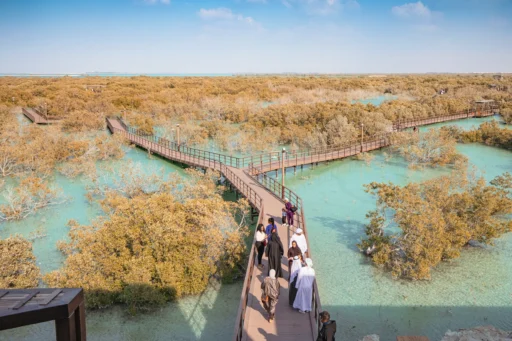
More than 70 sq km of mangroves can be found in Abu Dhabi (©Department of Culture and Tourism – Abu Dhabi)
1. It’s very green
Abu Dhabi may have a desert climate, and the Arabian Gulf helps to crank the humidity up to ten in the summer months, but that doesn’t mean the city is purely skyscrapers and sand dunes. Across the emirate, there are more than 70 sq km of mangroves, including the 19 sq km Mangrove National Park, also known as the Eastern Mangroves, and Jubail Mangrove Park, both of which are in the city proper.
You can tell you’ve arrived in Abu Dhabi when you notice palm trees start to spring up along Sheikh Zayed Road’s central reservation, and there are various initiatives to keep the city green, including mangrove replanting programmes. More than 850,000 were added to the coastline in 2024 as part of the Ghars Al Emarat initiative, which saw 10 mangrove trees planted for every visitor to the climate conference COP28 in Dubai the year prior.
Aside from mangroves, there are a number of brilliant parks dotted all over. Some of my favourites include Umm Al Emarat Park, which hosts an outdoor market every weekend during the winter months, and Sheikha Fatima Park, which is filled with restaurants and cafés.
Abu Dhabi is home to an exciting and diverse food scene (©Department of Culture and Tourism – Abu Dhabi)
2. There’s a diverse dining scene
Speaking of food, Abu Dhabi’s restaurant scene is thriving, and it’s only getting better as time goes on. There’s a perception that dining out here is expensive, and while there are certainly high-end dining spots for those looking to go all-out (Butcher & Still, Hakkasan, La Petite Maison and Zuma, to name just a few), there’s a lot of mid-range to budget options, too.
Along Mamsha Al Saadiyat, you’ll find the exceptionally well-priced Japanese spot NIRI, which was recently named among the 50 Best Restaurants in the Middle East & North Africa, homegrown Italian eatery Antonia, and Valgerand Nordic Grill. On Yas Bay Waterfront, there’s breakfast spot Art Market, ramen bar Daikan Izakaya and Mexican restaurant Barbossa. And Al Qana, near the National Aquarium, boasts a trio of Michelin Bib Gourmand spots: Otoro (for Japanese food), Tazal (for Middle Eastern) and Oii (for Mediterranean). If you’re willing to queue, the UAE’s best pizza can be found at Marmellata in Souq Al Mina.

Be sure to browse the catch of the day at the Fish Market in Mina Zayed and have it prepared and cooked as-you-like-it at one of the restaurants inside, dig into Malaysian noodles and curries at Kopitiam by Chandy’s, or grab a shawarma from Bait El Khetyar.
The emirate is home to some great rooftop options (©Department of Culture and Tourism – Abu Dhabi)
3. There’s just as much going on after dark
Nightlife-wise, Abu Dhabi is home to plenty of places to relax. Coffee culture is huge here. While you might prefer to limit your caffeine intake to the morning or early afternoon, in Abu Dhabi, coffee shops are busy night and day, with many staying open until midnight or 1am. Top choices include Local, Blacksmith Coffee Company (which many NYUAD students run on), and Joud Coffee.
Discover yoga among the mangroves (©Department of Culture and Tourism – Abu Dhabi)
4. There’s a big focus on wellness
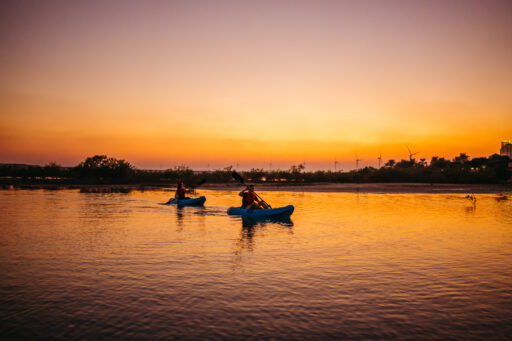
With so many options for foodies (including the legendary brunches…), it’s tempting to eat your way through the city and simply embrace the food coma. But in Abu Dhabi, nothing is done in half-measures: People play hard, but work out hard, too. Aside from stand-up paddleboarding and kayaking around the mangroves, there are run clubs along the Corniche, plus gyms to suit every workout preference, from boxing at Cobra Fitness and spinning at CRANK to hot yoga at Antara and pilates at The Reformr.
For those with a holistic approach to wellness, The Bridge in Al Qana has both a gym and a spa, and there are also various women’s only spaces like Reem Island’s FitnGlam, and Al Bateen Ladies Club by Matcha.
If getting some Vitamin D is a big reason for your trip, you can use the gym and sauna facilities at Saadiyat Beach Club before catching some rays by the beach. I’m often asked what to wear while on the beach in Abu Dhabi, and the answer is whatever you feel comfortable in, whether that’s a bikini, a swimsuit, or anything else. You may want to cover up more in malls (the A/C can be rather cold), but you’ll only need to wear an abaya and loose, modest clothing in Sheikh Zayed Grand Mosque or Abrahamic Family House, just as you would when visiting any other place of worship around the world.
Al Jahili fort in Al Ain (Shutterstock)
5. The UAE has a long history
While the United Arab Emirates itself only came into being in 1971, the Arabian Peninsula has been occupied by nomadic tribes for thousands of years. In Al Ain, you’ll find 5,000-year-old tombs at the base of Jebel Hafit mountain, as well as Al Ain Oasis, where nearly 150,000 date palm trees grow supported by the ancient falaj irrigation system. The city, around a 90-minute drive from the capital, also has the UAE’s oldest museum, Al Ain Museum, which has recently reopened after renovations, as well as forts like Qasr al Muwaiji and Al Jahili Fort.
Louvre Abu Dhabi museum (Shutterstock)
6. There’s a real focus on arts and culture
In a similar vein, Abu Dhabi is one of the most exciting cities in the Gulf in terms of culture, if not the world. There are big-hitters like Louvre Abu Dhabi and teamLab Phenomena Abu Dhabi, the newly opened Natural History Museum Abu Dhabi and Zayed National Museum, and the upcoming Guggenheim Abu Dhabi, but there’s a burgeoning contemporary scene, too.
Manarat Al Saadiyat has long been a key player, having first opened in 2009, with exhibitions showcasing local and regional artists throughout the year. CineMAS, the annual film festival, again puts the spotlight on MENA filmmakers, and there are bi-weekly meetups for photographers. Saadiyat Island is also home to NYUAD Art Gallery, which has shows from a mix of students and established artists. Over on Reem Island, Rizq Art Initiative, which opened in early 2024, features works from artists from the Global South.
One of the most exciting areas for creatives is undoubtedly Mina Zayed, the city’s port area. MiZa, a neighbourhood within Mina Zayed, is home to converted warehouse 421, which runs programmes year-round, with exhibitions, workshops and jamming sessions for musicians. Other warehouses are being converted into spaces for small and medium-sized creative and design businesses, with co-working and studio space M_39 already open. MAKE Abu Dhabi, which runs workshops for everything from sewing and ceramics to metalworks, also relocated here last year.
Masdar City is cleverly designed to keep it cool in the heat (©Department of Culture and Tourism – Abu Dhabi)
7. There is an emphasis on sustainability initiatives and innovation
Looking to the future, Abu Dhabi has unveiled a number of sustainability initiatives in recent years. Masdar City, a neighbourhood near the airport, is a good example of this, with a smart design that helps buildings deal with the desert heat, including windows that are angled to minimise direct sunlight, and a street layout that funnels winds through the shaded streets to keep it naturally cooler. Much of the building material was recycled, including the aluminium, with low-carbon concrete and sustainably sourced timber. There are 11 megawatts of PV panels throughout, and there are various green ways of getting around, including the Personal Rapid Transit (PRT) system and electric shuttles.
There’s no denying there’s a long way to go — car is still king throughout the emirate —but the launch of Etihad Rail (expected to open in 2026) will go some way to improve the country’s greener infrastructure.
Architectural structures help provide relief from the heat (©Department of Culture and Tourism – Abu Dhabi)
8. The summer is one of the best times to visit
While the emirate’s temperatures do soar to the mid-40s and even early 50s in the summer months, this is a place built to cope with the heat. Nomadic communities survived here by making use of architectural structures like windcatchers and mashrabiya screens on windows, but nowadays, air conditioning units keep visitors cool.
You can still relax by the pool under an umbrella no matter the weather, and many of the emirate’s attractions are indoors. You don’t even need to worry about not being able to exercise outside — during the summer, many malls host indoor races on the weekends, and the ADNEC Centre hosts Abu Dhabi Summer Sports, with indoor badminton, basketball, padel and tennis courts, cricket and football pitches, and a running track.
The real benefits, of course, involve your wallet. Hotel prices are a lot lower than peak season, and will often include credit to spend on food, drinks, or the spa, and there are dining deals galore. You also won’t have to deal with the crowds at top attractions, either.
For more information and inspiration, head over to the official Visit Abu Dhabi website.


