

British Break: Isle Of Arran, Scotland
Martin Symington heads to Scotland’s Isle of Arran, where the UK’s newest UNESCO Global Geopark offers a glimpse into both the island’s prehistoric past and bright future.
The pod of porpoises was a thrilling surprise. The jet-black dorsal fins that sliced through the Firth of Clyde alongside the ferry to the Isle of Arran tore my attention momentarily from the approaching silhouette of purplish humps crested by a line of jagged peaks. It was my first taste of a wild and ancient island that has recently found itself firmly in the spotlight. Back in April, Arran was declared a UNESCO Global Geopark, finally recognising its extraordinary geological heritage and diversity. The Highland Boundary Fault that slashes across the isle– just as it does mainland Scotland – divides it between craggy mountainscapes in the north and lowland moors and pastures in the south. Not for nothing is it known as ‘Scotland in Miniature’.
Hiking steep-sided Glen Rosa, I was plunged immediately into a geological wonderland. This U-shaped valley, bisected by the tumbling Rosa stream, is strewn with ‘erratics’ – rocks from differing eras ripped from the landscape during the last Ice Age, approximately 18,000 years ago, by glaciers. As I marvelled at these natural sculptures, I was once again distracted by the wildlife, as a circling golden eagle suddenly swooped down to perch on a hunk of curved sandstone.

I was discovering, by degrees, how the landscape had shaped everything about this island across the ages. It was easy enough to imagine why humans settled on Arran more than 6,000 years ago. With its fertile lowlands, its safe harbour and a mild climate warmed by the Gulf Stream, conditions were perfect. But there are still mysteries to be found here, not least out on the west coast, where I wandered astonishing stone circles and megaliths on Machrie Moor.
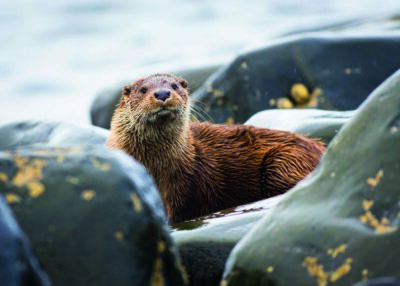
I was staying in a quaint little self-catering cottage, built from an upturned fishing boat, on the beach near Kildonan. Even here, history surrounded me. Nearby, a fossilised five-toed footprint of a giant reptile, which had trodden this shore some 240 million years ago, was hidden in the rocks. And in constant view, poking out of the sea, was Ailsa Craig, the uninhabited (save for a colony of gannets) tip of a volcano that has been extinct for 500 million years. While watching the sunset on my last night here, my imagination roamed the aeons until I was interrupted, once again, by the island’s wildlife. A pair of brown-furred sea otters slithered from a rock cleft and into the surf. It was a fitting end to my time on Arran, whose long history and wild nature never fail to surprise.
Ask a local
“Folk come to Arran to escape from many things. What you can’t get away from here is the geology. Everything that makes our island so special comes back to this in some way: our dramatic highlands and welcoming, fertile lowlands; the ancient stone circles and megaliths; and the flora and fauna.”
Sheila Gilmore, chair of Arran Geopark and CEO of VisitArran
Day 1
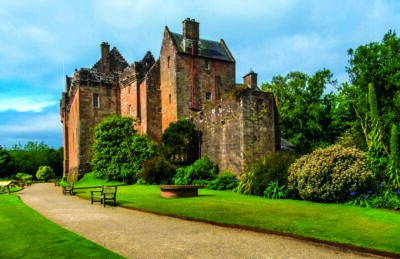
Begin in the gnarly north, starting in bijou little ‘capital’ Brodick (population circa 900), where the Arran Heritage Museum is an intriguing introduction to life on the island and a hub for the geopark. Next, head for the Glen Rosa campsite car park to begin a sensational in-and-out Glen Rosa hike. If you fancy a bracing dip, stop midway at the Blue Pool. Afterwards, follow the coastal road northwards, pausing at the Corrie shoreline to see the markings from a fossilised lightning strike that occurred 250 million years ago. Carry on to the 13th-century Lochranza Castle on the northern tip of the island. Nearby, you can walk among the glacier-scattered rocks of Hutton’s Unconformity, where 18th-century Scottish ‘father of modern geology’ James Hutton challenged theories about the Earth’s age that later influenced Charles Darwin and his theory of evolution.
After a snack-with-a- view at Weebly Sandwich Station (Apr–Oct), return to Brodick Castle. Between the fortress and the sea, its woodlands and gardens have been landscaped with subtropical plants. End the day with cocktails on the sand at Cladach Beach House and a delicious seafood supper at the Mara Fish Bar & Deli (Mar–Oct).
Day 2
Head south to the Coast Discovery Centre in Lamlash to get insights into the conservation efforts being undertaken to protect the waters here. Afterwards, bounce out to sea on a RIB with Lamlash Cruises, looking for sea eagles, dolphins and minke whales. Later, keep an eye out for red deer on ‘The String’ road that runs over the moors to the west coast. Once there, allow an hour to stroll the Machrie Moor Stone Circles before grabbing lunch at Café Thyme at the Old Byre Visitor Centre, where you can also pick up some hand-knitted Arran woollens.
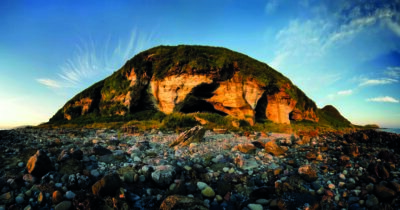
Nearby, walk the circular trail to King’s Cave, where legend has it that this was where Robert the Bruce had his famous encounter with a spider, whose determination to weave its web inspired him to continue fighting for Scottish independence. In the far south, near Kildonan, climb the stony track to Eas Mòr waterfall, which thunders impressively into a forested ravine below –especially after heavy rain. Finish in Lamlash at the Drift Inn by the water’s edge. Ask for a window seat; you’ll be greeted by magnificent views across to Holy Isle.
4 Side Trips
Stretch your legs by climbing Goat Fell (874m), the island’s highest mountain. This is Highland Arran in full majesty, with rocky ridges and harrowing precipices. On a clear day, the summit vista stretches across to mainland Scotland, the Isle of Man and the coast of Ireland. Allow most of the day to climb it.
Swirl, inhale and sip an array of gold and amber single malt whiskies aged in oak casks at Lochranza Distillery. Tour the gleaming copper stills and barrel rooms, then learn about the blending process before getting to taste the finished product at a visitor centre that feels too far-flung to be the centre of anything.
Keep your eyes peeled for red squirrels, which proliferate in the wooded areas all over Arran. Scan treetops, branches and forest floors for movement. Among the most reliable places for a sighting is the shrubbery of Brodick Castle gardens, where you’ll also find a discreet hide.
Hop on a boat at the Old Pier in Lamlash to cross the 2km-wide strait to Holy Isle, now in the care of the Samye Ling Tibetan Buddhist community. Keep an eye out for stupas, prayer flags and the heather-clad hump of Mullach Mòr, which is roamed by wild Eriskay ponies, Soay sheep and Saanen goats.
Getting There
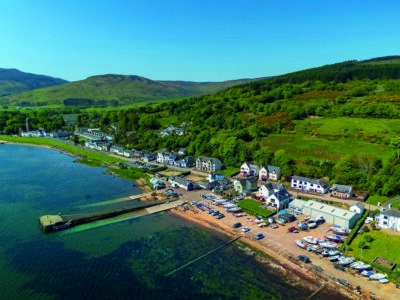
CalMac’s MV Caledonian Isles ferry from Ardrossan to Brodick (55 minutes) is being phased slowly back into operation following 20 months of repairs. Eventually, this will sail five times a day. The train from Glasgow to Ardrossan Harbour takes 50 minutes. CalMac also runs a ferry between Troon and Brodick, and a seasonal ferry (Mar–Oct) from Claonaig on the Kintyre peninsula to Lochranza.
Stay At
The Boathouse at Littlemill is self-catering, sleeps two people and lies just off the beach at Kildonan (from £140 per night; minimum two nights). Or try the four-star Douglas Hotel, which overlooks Brodick Bay and has doubles from £139 per night.
The author’s trip was supported by VisitArran and VisitScotland


