

What are the health risks to think about when flying long-distance?
We’re so used to long-distance flying these days that few of us consider the health risks involved, but should we be more alert? Dr Jane Wilson-Howarth slips on her flight socks to find out
Sad to say, but being stuck in a cabin full of people where the air is being recirculated does come with a risk of infection. The commonest bug contracted is a simple cold or sore throat, and those of us who fly a lot have come to expect a sniffle to emerge within a couple of days of a long-haul trip.
Yet most large, modern commercial aircraft are fitted with high-efficiency particulate arrestance (HEPA) filters. These strain out most particles, even down to the size of viruses, it is claimed. The International Air Transport Association (IATA) even argue that aircraft air should be better than the unfiltered shared air on buses and trains. But is this the case?
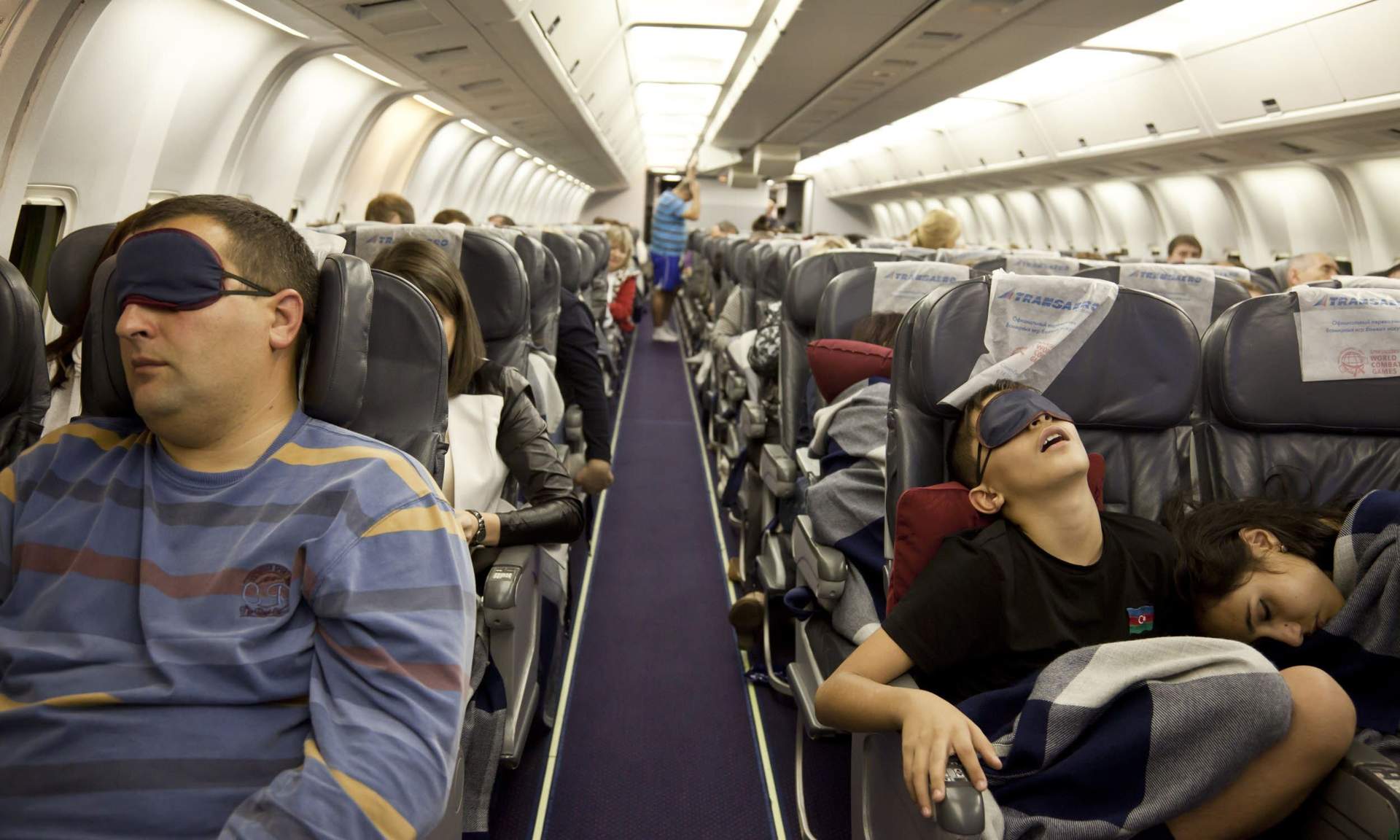
Passengers in plane (Dreamstime)
Who’s at risk?
For the IATA’s claim to be valid, the system has to be well maintained. The filters need to be changed on a regular schedule and continually switched on during flight. But filtration ‘costs’ fuel, so frugal airlines may not run them as much, and I’ve certainly been on flights where the cabin air felt thick. In this situation, ask the cabin crew to run the AC. Air quality is more likely to be a problem in older aircraft and on budget fares.
Many filters draw air from the centre of the plane to vents at the sides, so others passengers’ exhaled air will pass by you; this is how colds and other infections can be caught. Of course, travel with an infectious disease is forbidden, however many microbes are most infective before diagnosis is obvious. In chickenpox, for example, the virus can be spread via droplets in the air during the 24 hours before the rash is apparent. This is perhaps why this infection is commonly acquired on flights.
Those most likely to suffer flight-acquired infections are smokers and those with poor lung function. Most masks won’t protect you unless you are prepared to wear one of the densely weaved variety, and these can be uncomfortable when worn for long periods.
If you’re on a short stopover, move around as much as you can. Ideally do something to get your breathing and heart-rate up, like going up and down some stairs. Exercising enough to cause slight breathlessness will encourage you to cough up any small particles in your lungs and helps avoid infection. It will also reduce the risk of a blood clot.
Plane taking off (Dreamstime)
Don’t be a clot
Flight-associated blood clots start in the leg veins and can break off to lodge in the lungs. Being immobile allows blood stagnation, which increases the risk of a clot, and flights longer than five-and-a-half hours also make them more likely. Those who make multiple smaller trips within a short timeframe are likewise at risk.
Quantifying this danger isn’t easy, but in the general population as many as 10% of long-haul travellers appear to develop tiny clots, which have the capacity to seed other larger clots. The chance of developing a flight-associated clot is at least one in 50,000 on flights of all lengths. Few clots are fatal and the survival rate is over 98%, but there is a risk the affected leg could be permanently swollen.
Movements that mimic the muscle contractions of walking – especially calf contractions – keep the body’s blood from stagnating, and so reduce risk. Properly fitted flight socks can also provide protection, while occasionally getting up and walking around is a good idea. Paying more for a flight often affords more room (and better air), thus more scope for exercise.
It is also important to hydrate,and imbibing a lot of alcohol, so that you sleep for much of the flight, isn’t a good idea, as this can cause dehydration, which makes the blood thicker and more prone to clot. Similarly, sleeping pills might increase the risk of a clot, especially if you are uncomfortable. Seat edges can compromise circulation and this explains why the risk of a clot is greater in the very tall or short.
Genes may likewise play a role. The factor V Leiden gene is often found in people with European ancestry (in 3–5%), and those who inherit it from both their parents (about one in 5,000 in Europe) are at high risk of a clot. However, this can be detected in a blood sample. Some travellers who are identified as being high risk – the pregnant, those with factor V Leiden, or who have suffered clots – may be advised to give themselves heparin injections to prevent problems.
Lastly, there have long been discussions among health experts over the value of taking 75mg of aspirin before a flight. Some promote this; others disagree. Aspirin reduces the risk of clots in the arteries (hence its use in preventing strokes or heart attacks), but it probably has little effect on the veins, so is unlikely to be of use with flight-associated clots – but nor will it likely do you any harm.
Travellers that are especially at risk of clots
- – Those with blood relatives who have experienced a clot – they may have inherited the factor V Leiden gene.
- – Anyone who has had a clot before, unless they are taking the oral anticoagulant warfarin.
- – Those who have had major surgery, a serious leg injury, or a hip or knee replacement in the previous three months.
- – Cancer sufferers, or those who have had treatment for cancer in the previous six months.
- – People with poor circulation due to heart disease.
- – Anyone who has ever had a stroke.
- – The over-80s.
Travellers with a slightly increased risk
- – Smokers.
- – The over-50s.
- – The very tall (over 1.82m) or short (under 1.52m), and those who are considered obese (body mass index over 40).
- – Pregnant women, or those having given birth in the last six weeks.
- – Women taking the combined oral contraceptive pill.
- – People with very severe varicose veins.
Main image: Flight outside New Zealand (Dreamstime)