

Journey back in time in the Philippines with a visit to its three cultural UNESCO Heritage sites
UNESCO sites in the Philippines showcase a rich blend of indigenous heritage, Spanish influence, and timeless cultural landscapes

The Philippines boasts six UNESCO World Heritage sites, which are designated due to cultural, scientific, and historical global significance. Three of them recognise this country’s characteristic fusion of indigenous culture and historic colonialism. Their preservation allows travellers to open a time portal back to pre-Christian culture, Spanish rule, and Catholic identity.
Vigan, Ilocos Sur

I once arrived in Vigan in early evening. The clip-clopping hooves from horse-drawn kalesa carriages on Calle Crisologo’s cobblestones, allied to the murmur from restaurants and bars and beautifully-lit heritage homes highlighting brick-and-wooden facades with high-pitched tiled roofs, was a heady introduction to Asia’s best-preserved Spanish colonial city.
This once important trading city on the River Abra delta grew in prominence from 1565. Wealth flowed in. Now the grid-patterned streets of largely 18th-19th century construction are bejewelled with classical homes, pretty plazas, and baroque churches – the fulcrum of which is St Paul’s Metropolitan Cathedral. Vigan has by no means been immune to change, nor is it 100% preserved. But it’s magical to explore on foot, munching on signature empanadas, visiting heritage homes, enjoying cafes, and marvelling at its opulent splendour.
Miagao Church, Iloilo
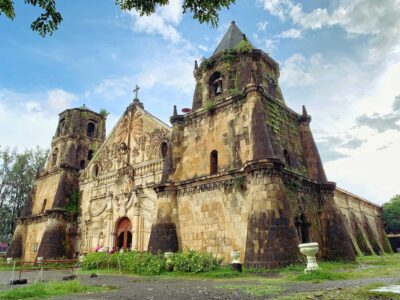
Four places of worship comprise the UNESCO World Heritage prescription cited as: ‘Baroque Churches of the Philippines’. Miagao church is located in Iloilo in the Visayas chain. Completed around 1797 it’s dedicated to Saint Tomás de Villanueva. Thick-walled and of an adobe and coral limestone construction, the façade’s bas-relief between two bell towers is an extraordinary representation of Baroque-Romanesque decoration that, recognising a multi-ethnic congregation, fuses Filipino, Chinese, and Spanish designs. Most pleasing is St Christopher in traditional island garb standing by the Tree of Life – in this case, a coconut palm. The interior is less fanciful, yet the barrel-roofed nave glitters with a gold-plated retablo.
Do pause outside it to read a plaque succinctly summarising the circumstances of its current reincarnation, forged from a tumultuous history. The solidity of form doubled up as a fortress against ‘Muslim raiders’, it reads. It was destroyed by revolutionaries in 1898, then rebuilt, damaged by fire in 1910, and then by an earthquake in 1948. Its side wall buttresses likely prevented total collapse.
Banaue Rice Terraces, Ifugao
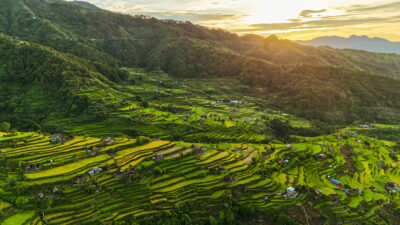
After a long overnight bus journey towards Batad in North Luzon, as daylight formed I experienced an agricultural grandeur never seen before. Stepped for kilometres up the mountainsides, terraces of lime-green planted rice were staggered like a giant’s stairway to heaven. The mountain’s adaption for food production in difficult terrain has formed huge sinuously ribbed amphitheatres that are the culmination of two millennia of design. If an 8th wonder of the world is ever required the rice terraces of the Philippine Cordilleras must be in pole position.
An atmospheric base to explore from is Batad, with little guesthouses and simple restaurants with some excellent hikes and local Ifugao guides. Some hikes are scenic meanders to viewing points, others exhausting daylong efforts. Batad is a hub for the culture of this landscape’s creators, the Ifugao people. This indigenous group retain strong connections to former animist ways of life. Visitors can learn about celebrations that are intrinsically linked to the harvest and planting of rice, while buying handiwork crafts supports their local community.


