
Preserving Indigenous artisanal practices with Paola Lema
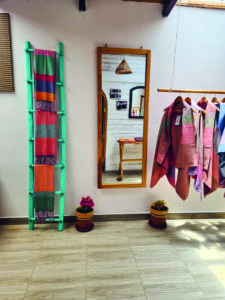
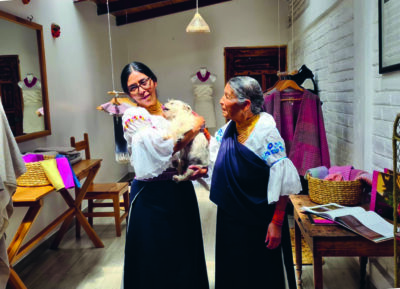
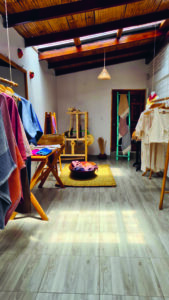
Paola Lema and her mother, Matilde Lema Jimbo, run Casa Matico/Huarmi Maqui in the pueblo of Peguche, just outside Otavalo in northern Ecuador
As processes, including those used in various crafts, become increasingly mechanised around the world, artisans in Ecuador are working hard to preserve their traditions. Paola Lema is one such artisan who, alongside her mother, Matilde Lema Jimbo, runs Casa Matico/Huarmi Maqui in the pueblo of Peguche, just outside Otavalo in northern Ecuador. Paola shares the story behind Casa Matico/Huarmi Maqui, why it’s so important to maintain artisanal practices and how travellers can experience the centuries-old heritage of loom weaving when visiting Ecuador.
Can you tell us about Casa Matico/ Huarmi Maqui? And what does the name Huarmi Maqui mean?
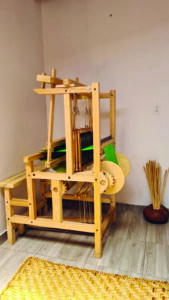
Huarmi Maqui are two Kichwa words which mean “woman’s hand” – because it’s a business that’s directed by women, my mother and I. My mother, Matilde Lema Jimbo (Matico), started this project; today, she’s 80 years old. It’s a workshop that’s dedicated to loom weaving, and it’s entirely artisanal because everything we make is by hand. The workshop was founded in 1999 by name, but our traditions have existed in our community (the Indigenous community of Peguche in northern Ecuador) for much longer than that.
How did you learn this craft?
My mother used the loom from a very young age because she’s the eldest daughter. It was more a responsibility for her to learn; no one had to tell her to pick it up. It’s the primary job at home, and one that helps economically. In my case, I grew up watching and observing textures, colours and forms. When I first had a go on the loom as a little girl, it wasn’t difficult for me because I was creating patterns that I’d already lived and were already in my memory.
What kinds of artisanal crafts do you create?
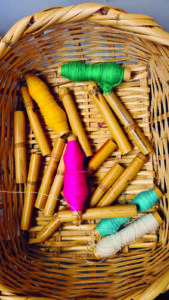
Traditionally, weaving has always existed in our community. We always try to weave with natural fibres, such as sheep’s wool, cotton threads or alpaca wool, because we want everything that’s created in the workshop to be natural. We weave blankets, scarves and shawls. By weaving, we’re also able to tell our story. We weave artisanal garments, but we also believe that our pieces tell stories and recount lives. When I speak about the story of Huarmi Maqui, I’m also speaking about my mother’s life because she’s the founder of this project.
Why are these artisanal crafts important for the community in Otavalo?
These crafts and workshops come from generations who are now leaving us and dying. Our weaving culture isn’t written down; we’re more of an oral culture. The designs from our ancestors were never recorded; they were only committed to memory. Today, we have very few textile patterns in our workshop because my grandmother died. My mother is the one who continued this tradition as part of her heritage, and now I’m doing the same. It makes me realise that manual artisanal workshops encourage us to look back and understand where we come from, which pueblo we belong to, what we’ve lived through. I feel that artisanal workshops safeguard stories that enrich us as an Indigenous culture, and they enrich us as humans.
How can travellers visit Casa Matico/Huarmi Maqui and take part in workshops to learn more?
People can come and visit us. We are in the province of Imbabura, just 10 minutes north of the town of Otavalo. We’re based in the village of Peguche. If people want to participate in a workshop to learn more about the craft, they can contact us, and we will create a tailor-made workshop for them. We work in a reserved way because we only want to do the workshops with groups of four or five people at a time, so we don’t have fixed times for workshops. We’re very active on Instagram, and visitors often find us that way, so travellers can also contact us there (@huarmimaquicasamatico). Visitors know that we’re responsible in how we create things and that our crafts are of high quality. Our work is my community’s legacy.


