
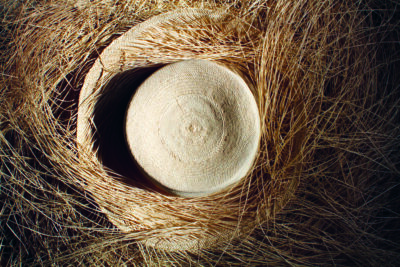
Did you know: The Panamá hat is actually from Ecuador
Trace the origins of the Ecuadorian toquilla straw hat and you will find a tradition that has been passed down through the generations
It’s one of the most persistent misnomers in the fashion world. The elegant, hand-woven, natural straw hat known globally as the ‘Panamá hat’ is not from Panamá at all – it’s Ecuadorian. And not just loosely so: the art of weaving toquilla straw hats was born, perfected and passed down through the generations in Ecuador, long before the world misbranded it. Wander Cuenca’s colonial centre or the coastal town of Montecristi and you’ll soon see why Ecuador remains at the heart of this tradition. In 2012, UNESCO recognised the weaving of toquilla straw hats as part of the Intangible Cultural Heritage of Humanity, affirming what locals have always known: this is more than a fashion item; it’s an ancestral craft – one that is deeply tied to place, people and identity.
From Montecristi to the world
The story begins in Montecristi, an Ecuadorian coastal town where, as early as the 17th century, local artisans were weaving hats from the pliable fibres of the Carludovica palmata, a plant that grows in the humid lowlands. Known for their durability and breathability these finely woven hats were practical, stylish and perfect for the tropical sun. By the 19th century, the nearby Andean city of Cuenca had become another hub of production. Easier to access from Ecuador’s interior, it o ered a broader base of weavers and a growing market. Hat-making became such an essential part of local life that schools introduced it as a formal subject. Locals learnt how to split and soften the palm fibres, how to weave the crown and brim, and how to tighten and shape each strand with precision. In some areas, this education was less a choice and more a necessity. “It was obligatory in many schools,” said Gabi Molina Ortega, the fourth-generation manager of the renowned Homero Ortega hat workshop in Cuenca. “For parts of the population, it wasn’t just a tradition, it was a livelihood you were expected to learn.”
A woman’s weave
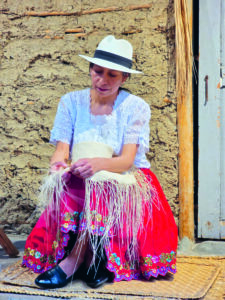
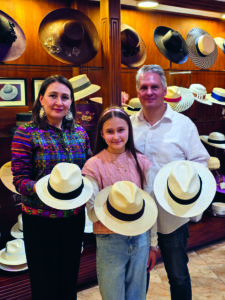
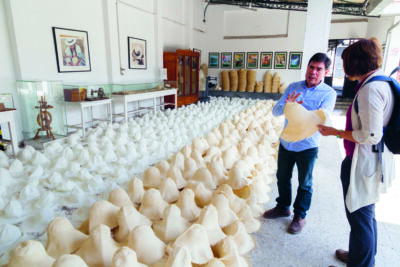
I met Gabi in the family’s Cuenca workshop, along with her husband and daughter – part of a new generation already immersed in the business. Her grandfather, Homero Ortega, founded the company, but her great-grandfather was already skilled in the craft. Today, the business exports hats to Europe, the US and beyond, continuing a family tradition spanning five generations. Perhaps one of the most quietly revolutionary aspects of the toquilla straw trade was the way it opened doors for women. Weaving hats became one of the first ways that Ecuadorian women could earn an income independently. “This was the first time in our local history that women had a way to make their own money,” Gabi told me. “It gave them freedom, status and a sense of pride. Some became the best weavers in the region.” Walking through the workshop today, you can see the different stages of production – from soaking the fibres to shaping the crown and carefully ironing each finished piece. No two hats are quite the same, and many take weeks to make, especially the high-end Montecristi finos, whose weave is so tight and intricate that they feel like linen to the touch.
Why an Ecuadorian icon is known as a Panamá hat
Gabi explained how the mislabel traced back to the 19th century, when Ecuadorian hats were exported via Panamá, then a busy trade hub en route to North America and Europe. Workers digging the Panamá Canal wore these breathable straw hats, and when US President Theodore Roosevelt was photographed wearing one during a 1906 visit to the canal construction, the association stuck. From then on, the name ‘Panamá hat’ went global, obscuring the hat’s true origins and eclipsing the communities that made them. Today, Ecuador is reclaiming its heritage with confidence. Visitors to Cuenca and Montecristi can see the weaving process firsthand, purchase hats directly from artisans and join workshops. For Gabi and the Ortega family, education and appreciation are key. “We don’t mind if people still call them Panamá hats,” she said with a smile. “But we want them to understand the history. We want them to value the work, the culture, the time it takes. These hats aren’t just something you wear; they’re something you carry from generations of Ecuadorian hands.


