

7 of Vietnam’s best walking and hiking routes
From wildlife walks around Cuc Phuong National Park to adventures exploring the world’s largest cave, it’s time to pull on your walking shoes
From the deep winding valleys of Ha Giang and the terraced rice fields of Sapa, to the steamy hills of Cuc Phuong National Park, Vietnam’s lovely landscapes have long lured hikers.
Whether it’s short walks to temple top-mountains or long treks between hill tribe villages, multi-day trips through vast networks of caves or gentle jungle trails through gibbon-filled forests, here are Vietnam’s best walking and hiking routes (and when to tackle them).
Cuc Phuong National Park

Where: Ninh Binh, North Vietnam
When: Dry Season, December-May
Best for: Spotting wildlife
Vietnam’s oldest and largest protected area is an easy visit from Hanoi. With rivers winding around rippling limestone mountains covered in forest, the landscapes are lush and beautiful. But the main draw here is the wildlife, especially the primates, which include three critically endangered species: Delacour’s langur, golden-headed langur, and black crested gibbon. The park is heavily visited and there are many self-guided easy walks, including the popular 4-kilometre 1,000-Year-Old Tree Walk. Maps are available from the visitor centre.
For longer hikes away from the crowds – like the Muong Village and May Bac Mountain summit trek (with breathtaking views), you should organise a guide.
Read next: 9 of the best things to do in Hanoi
Sapa’s Indigenous villages
Where: Sapa
When: October-April
Best for: Connecting with locals through a homestay
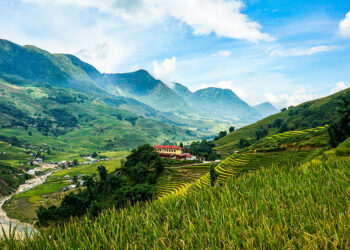
Valleys dotted with pretty hill tribe villages and stepped rice fields, mountain ridges poking through seas of fluffy clouds, orchid-filled jungles… Sapa has plenty to offer hikers. And there are plenty of hikes – from one day walks to four-day treks. All offer a similar recipe – walks through rural and wild mountain landscapes, sweeping ridge and valley views, visits or homestays in Indigenous villages. But with so many visitors, the region can feel backpacker-packed, so to avoid the crowds opt for a longer walk. Some of the best routes involve crossing the rushing Muong Hoa River, past some of the most extensive terraced rice fields in Vietnam and entering the Red Dao, Hmong and Xa Pho tribal areas around Giang Ta Chai and Ban Ho. You’ll need a guide for any hike, easily booked through a company like trekkingtoursapa.com.
Read next: Our guide to the best time to visit Vietnam, no matter your itinerary
Fansipan Mountain

Where: Sapa
When: October-April
Best for: Jaw-dropping views
Climbing Vietnam’s highest mountain has long been a backpacker badge of honour. The views from the 3,147.3 metre summit, over seas of cloud and seemingly endless rugged slopes and rocky ridges, is jaw-dropping. You can do it in a day, dragging yourself up steep paths, through muddy rainforest and over slippery, root-tangled slopes. Or take it slowly, camping on the mountainside en route. Either way it’s a schlep. And nowadays it’s possible to have those views without even breaking a sweat, in 15-minutes, by cable car.
Hang Son Doong
Where: Phong Nha-Ke Bang National Park
When: February-August
Best for: Adventurers seeking out a new challenge
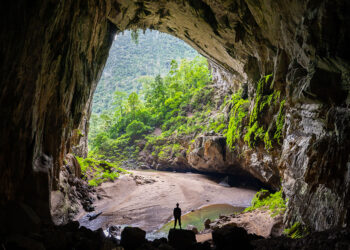
Hang Son Doong, the world’s largest cave (though not its longest), is so vast that you could fly a super-jumbo through it with room to spare; and so extensive that to have a good look you need to overnight inside in order to see it properly. Visitor numbers are strictly controlled and pricey. You can only visit in a group, pre-booked up to a year in advance. You need a week for the hike, which includes the jungle walk in and sleeping in Hang En, another vast cavern en route. But as Son Doong sits in the limestone mountains of Phong Nha-Ke Bang National Park, which are honeycombed with thousands of caves, there are myriad other caverns to hike to and through in the area.
Con Dao Archipelago

Where: Con Dao Archipelago
When: November-February
Best for: Wonderful viewpoints without the crowds
Vietnam’s offshore islands offer a range of great day hikes. Titov Island, which is usually visited on a Halong Bay cruise has a peak reachable in less than an hour with wonderful views of the bottle-green ocean and pinnacle islands. Halong Bay is always busy, but the Con Dao archipelago in south Vietnam has the best of the country’s island hikes and it receives a fraction of the tourists. Con Dao’s trails, nearly all of which lead to lovely viewpoints over lush forest, long white beaches and a turquoise coral sea are easy and can be hiked independently. And if you visit during the week then you’re almost guaranteed to be sharing the views with just a handful of people. The best of the bunch is the Plantation Lookout hike, which has stunning views all the way and the lookout at the top sits over Côn Sơn town, a vast bay, headlands and a string of beaches.
Ma Pi Leng Pass
Where: Ha Giang
When: March-May & September-October
Best for: A more immersive way to explore the Ha Giang loop
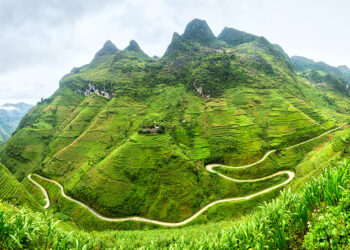
Ha Giang in Vietnam’s far north rivals Sapa for idyllic mountain and rice paddy field beauty but is far less visited by hikers. Most tourists who make it here come to drive the Ha Giang loop, a two- or three-day bike or car ride that winds through gorgeous mountain scenery. Walks immerse you in it. The Ma Pi Leng hike offers breathtaking views: mist clearing to reveal distant villages set in the bottom of a steep valley, a shaft of sunlight catching a farmer in a conical hat tilling one of myriad terraces. The summit of the pass itself – reached on the sky path, which you can walk in around 2 hours, is stunning – as you are in the midst of endless rippling mountain ridges, huge domed mountains covered in forest plunge at tour feet to the winding Nho Que River. You can do the hike as a side excursion on the Ha Giang loop; or to really get off the beaten track beyond the backpackers, and immerse yourself in H’mong and Tai Indigenous life, make it part of a multi-day hike.
Dalat

Where: Ha Giang
When: November-March
Best for: Easily accessible routes
Travellers flock to Dalat for the waterfalls – there are dozens dripping from the forested hills and they’re nearly all easily accessible by road. But Dalat offers great day hikes, too.
Top of the list is the three-hour walk to the summit of Mount Lang Biang. The trail leaves from the visitor centre, runs along a dirt road and then cuts up into pine forest before ascending steeply into dense jungle, on a series of steps. Villages and valleys spread at your feet from the summit. It’s easy to organise a guided hike in Dalat, and you can even get up the mountain on a Jeep tour… But the hike’s much more fun.


