
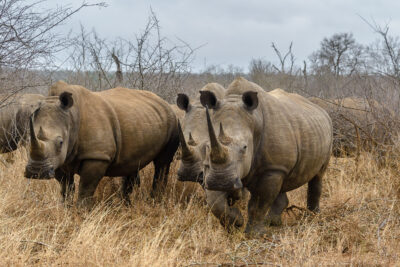
World Rhino Day: The best places to see rhinos in the wild
Lyn Hughes reveals the best places to still see these magnificent horned beasts around the world, and how to help protect them…
Marked every 22 September, World Rhino Day aims to raise awareness around the threats being faced by the five rhino species – white, black, greater one-horned, Sumatran and Javan – today.
While black rhino numbers continue to rise, the white rhino population is declining due to poaching and the effects of climate change on habitats and water sources, reports Save the Rhino. Both Sumatran and Javan rhino populations are still on the brink, and while the greater one-horned population has grown slightly, the species remains vulnerable.
If you’re looking to see these magnificent creatures in their natural habitat, and support conservation efforts while doing so, here are the best places you can see rhinos in the wild around the world.
1. Namibia

As the first African country to incorporate environmental protection into its constitution, it’s no surprise Namibia has been such a huge conservation success story. Around 42% of the country is under some sort of protection, with local community conservancies accounting for 20 per cent of that. Communities benefit from tourism activities, which creates jobs and revenue in rural areas.
Not only is Namibia one of the only countries where the lion population is increasing, but the numbers of black rhino have grown to more than 2,200 (as of 2023), with 1,400 white rhino living here, too, the second most in the world after South Africa.
The main populations can be found in Estosha National Park and the Kunene area, the Palmwag Reserve, and also on private land and in community-run conservancies under a unique custodianship programme.
Uniquely, the south-western black rhino of the Kunene region are desert-adapted, covering huge areas, climbing mountains and drinking only every few days. White rhinos can be found in Etosha National Park and the Waterberg.
Read next: Namibia trip planner: 6 of the best in-depth routes
2. Kenya

Another success story, Kenya‘s rhino population has more than doubled to 1,000 individuals (as of February 2024), up from just 400 in the 1980s. By 2037, the Kenya Wildlife Service hope to get this number up to 2,000.
Although there are rhinos in some of Kenya’s national parks (try the Mara Triangle for the best chance), more than half of the country’s rhinos live in heavily guarded private reserves.
Lewa Wildlife Conservancy has the largest population of black rhino in East Africa, with 273 rhinos today, having started with just 15 in 1983. Elsewhere in the country, the not-for-profit 90,000-acre Ol Pejeta Conservancy has 165 black rhinos. The conservancy was also home to Sudan, the last male northern white rhino, before he died, and where you’ll find the last two northern white rhinos still alive, both females. It is hoped they will provide a breeding population with Sudan’s semen, saved for posterity. Ol Pejeta has a range of accommodation and welcomes day visitors too.
Read next: Safari etiquette is about much more than getting the shot – it’s life and death for these animals
3. Eswatini
Eswatini, formerly known as Swaziland, may be small, but it punches well above its weight, being one of the best places in Africa to see free-roaming rhino.
Beautiful Hlane Royal National Park is home to a wide range of flora and fauna including lion, giraffe, vultures, the placid white rhino, and the occasional black rhino. You can self-drive, or by booking onto a ‘Rhino Drive’ you get the opportunity to approach the rhino on foot, giving you an astonishingly close view.
Mkhaya Game Reserve in the south-east is rugged bushland dotted with thorn trees, which makes it probably your best chance of seeing black rhino in the wild in Africa. Get intimately close with a guided tour on foot. You’ll also see elephant, hippo, buffalo and birds.
Both reserves have varied accommodation options and offer excellent value for money compared to many African parks and reserves.
Read next: Eswatini: Africa’s biggest little secret
4. South Africa

World-famous Kruger National Park is one of the biggest reserves in Africa. It is home to both black and white rhinos as well as a wealth of other wildlife. Your best chance of seeing rhino is in the southern part of the park where white rhinos are commonly spotted.
While not as well known, Hluhluwe–Imfolozi Park in KwaZulu-Natal is the oldest nature reserve in Africa and certainly one of the best for wildlife viewing. Often heralded as being the birthplace of rhino conservation, it has one of the largest populations of white rhino in Africa, and also a substantial population of black rhino.
5. India

Only 600 one-horned rhinos remained in Asia in 1975, but now, thanks to strict protection from Indian and Nepalese wildlife authorities, these numbers have increased to around 4,000 today.
Around two thirds of these live in Assam’s magical Kaziranga National Park. You are almost guaranteed to see one-horned rhinos on the open plains here and you can see the Jurassic-like creatures either on a jeep or elephant safari.
Kaziranga, bordered in the north by the Brahmaputra River, is a mix of forest grassland, marsh and pools. It floods in summer during the monsoon – the river bursts its banks – and 2012 was a particularly tough year, with some rhinos lost to high floodwaters and poaching.
Going between November and February, when the climate is mild and dry will increase your chances of spotting rhino.
The park has a significant tiger population too and its name has been extended to include ‘Tiger Reserve’, though you’d be very lucky to spot one in the tall elephant grass.
Other mammals here include elephant, swamp dear, and sloth bear, while there are 490-plus species of birds. Book onto the park’s birdwatching tour for four days of spotting the various species.
Read next: Wildlife in Rajasthan: In search of tigers, chinkara and Indian wolves
6. Nepal

Nepal is the other stronghold for the one-horned rhino. The country has been a rare conservation success story in the past few years, and an estimated 750 one-horned rhinos remain in Nepal (as of 2021). Most can be found in Chitwan National Park, in the country’s southern Terai lowlands.
You can explore the park by foot, jeep, or elephant safari. As well as the rhino, the park is also renowned for its protection of royal Bengal tigers, gharial crocodiles and is home to over 60 mammals, 500 plus species of birds and more than 120 variations of fish.
There are several renowned lodges deep inside the park; the village of Sauraha, just outside the park on the Rapti River, has a range of accommodation to suit all budgets. The village is also actually one of the best areas for rhino-spotting – the animals have been known to cross the river at night to raid crops.
Read next: Wild Nepal: The best of wildlife in Chitwan National Park
7. Indonesia

The Sumatran rhino is sadly the most in peril, with fewer than 50 left in Asia today. There’s been an astonishing population decline of 70% in the last few years. They are the most endangered large animal on Earth.
Recently, the Sumatran rhino became extinct in Malaysia. In November 2019, it was sadly reported that Malaysia’s last Sumatran rhino – a male – passed away of natural causes.
Today, the most likely place you’ll spot a Sumatran rhino is at Way Kambas National Park in southern Sumatra, Indonesia. Its plans for breeding offers hope to the species, leading to the planned doubling of the sanctuary’s size. A new breeding facility opened in 2019, and in 2023 the park hit the headlines thanks to Delilah, the first captive-born Sumatran rhino to give birth. There are also small populations of the Sumatran rhino in Borneo.
Javan rhinos are also critically endangered and are also secretive and live in dense tropical forest, so they are very hard to see. The Javan rhino is the rarest of all. They used to be found in Vietnam as well as Indonesia, but what was believed to be Vietnam’s last remaining individual was killed in October 2011. A tiny population of around 76 lives in Ujung Kulon National Park in Java.
Read next: World Orangutan Day: 5 of the best places to see orangutans in the wild


