
Our guide to Vietnam’s UNESCO World Heritage Sites
From the limestone karsts of Ha Long Bay to the Imperial Purple City of Hue, these sites mix natural beauty with the country’s long and rich history
Bays of pinnacle islands, forested mountains carved out by huge canyons, crumbling temples and ancient Forbidden Cities… Vietnam’s scattering of UNESCO World Heritage Sites mix natural beauty with the country’s long and rich history.
And unlike so many elsewhere in the world, they’re all easy to reach, as they are conveniently strung out along the North-South railway line, close to the main tourist hub airports.
Their nomination by Vietnam is indicative of the country’s political power and cultural balance. All are in the North. At least for the moment. Cat Tien National Park (close to Ho Chi Minh City) and the ancient ruins at Oc Eo, in the Mekong Delta, are on the UN’s tentative list for inclusion. But until those are confirmed, here’s our guide to all of Vietnam’s current UNESCO World Heritage Sites.
Ha Long Bay and the Cat Ba Archipelago

Where: Near Hanoi
Mundane geology seems too banal for Ha Long Bay’s mystical beauty. According to legend, the bay was formed when patriotic dragons spat emerald and jade mountains into the sea to create a walled fortress against invading armies from China. The remnants of those walls are what you see today in the Cat Ba archipelago: over one thousand green, forested islets pocked with grottoes and jutting almost sheer from an impossibly placid, emerald sea.
A cruise around the bay in a luxury small boat or a converted Chinese junk is one of Southeast Asia’s do-before-you-die experiences. Take a two night cruise to see the best of the bay.
Read next: 7 reasons you should visit Cat Ba Island, Vietnam
Complex of Hué Monuments
Where: Hue, Central Vietnam
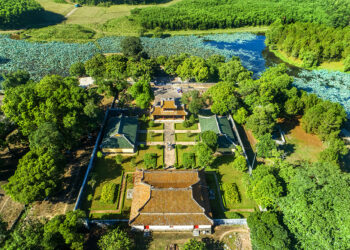
Most visitors to Hue City whizz through, spending less than a day to explore the city centre and missing everything else. There’s lots to see. Top of the bill is the citadel and Imperial Purple City, which was modelled on the Forbidden City in Beijing – with palaces and temples set around stately squares lined with long ceremonial corridors, many of them with traditional Chinese-style arches. It was badly damaged during the US-led Tet Offensive in 1968, but is gradually being restored with UNESCO funding.
A boat ride down the Perfume River from here brings you to the gorgeous, tiered Thien Mu Pagoda, perched over the water like a sacred lighthouse.
In the surrounding countryside, there are myriad Imperial tombs. They include the Nguyen Tran Princess Temple – built in homage to a Vietnamese princess who devoted her life to peace and surrounded by a beautiful pine forest, and the 20th century tomb of Kai Dinh, whose interior is covered in a filigree of European Gothic and Baroque-influenced carvings.
And don’t miss Gia Long: a complex of mausoleums and temples covering 42 hilltops. It is a wonderfully tranquil spot, with little to disturb contemplation beyond the twittering of birds.
Read next: 11 of Vietnam’s most spectacular temples and shrines
Hoi An Ancient Town
Where: Hoi An
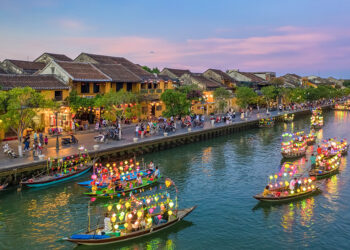
Candle-filled lanterns and gondoliers of courting couples floating along a glassy-calm river, faux-Japanese covered bridges right out of a Hayao Miyazaki movie, rows of ochre town houses topped with tumbling terracotta and home to chic little boutiques and restaurants… Hoi An is delight. But it’s more than pretty. The town is one of very few surviving old Southeast Asian port towns.
The street plan and most of the buildings in the old centre are original and intact – showcasing a traditional 17th and 18th century townscape which is unique in Vietnam. Chinese, Japanese, Portuguese and indigenous Cham and Vietnamese all added to Hoi An’s heritage and left their mark in buildings, temples, decoration and in the faces of the people themselves.
Read next:
My Son Sanctuary

Where: Near Danang and Hoi An
With vine-smothered ruined temples covered with intricate carving and sitting in lush jungle, My Son feels like a miniature Angkor Wat. Without the crowds. Few tourists make it here, despite popular Hoi An and Danang being just an hour’s drive away.
In its heyday, between the 4th and the 13th centuries, the ruins lay at the heart of the capital of the Champa Kingdom, which ruled much of what we call South Vietnam today, eventually losing power and influence to the Khmer of Angkor and then the conquering Vietnamese. Like the ancient Khmer, the Cham were Hindu and you’ll see carvings of Shiva, Krishna and Vishnu all over the crumbling tower temples. These themselves are Earthly echoes of mythical Mount Meru, home of Hindu pantheon and nexus of the universe, reproduced at the centre of the Champa Empire. The best time to visit is in the early morning or late afternoon – when the birds are most active in the forest and the temples bathed in warm light.
Phong Nha-Ke Bang National Park

Where: Quang Binh Province, North Vietnam
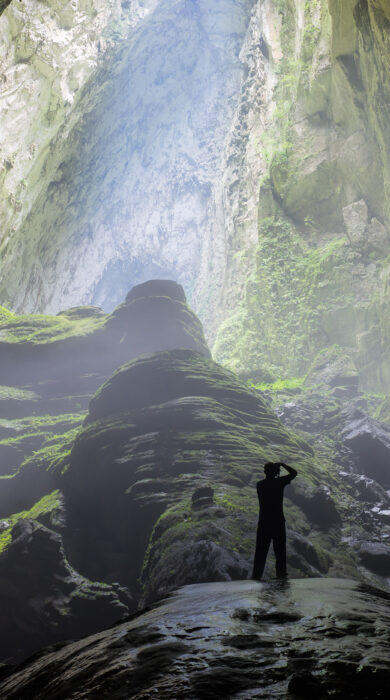
Rivers winding through serrated karst hills, plateaux of rice paddies and lotus-flower lakes, hill tribe villages lost in vast mountains honeycombed with the largest caves on Earth… Phong Nha is astonishing. The caves are the star attraction. Some are easy to visit – with boardwalks running past beautifully illuminated walls of glittering flowstone and hulking stalactites and stalagmites. You can see others on a gently drifting sampan boat ride or an adrenaline-rush through the inky dark. Others are so remote you need to hike through hill tribe villages and dense forest to reach them. And the largest, Hang Son Doong, is so vast you need days inside to see it, camping along the way in caverns filled with cave pearls.
Imperial Citadel of Thang Long
Where: Hanoi
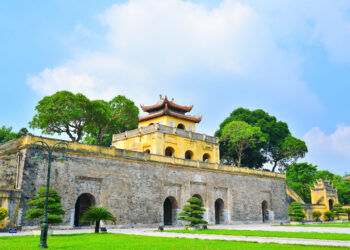
On a wander through Hanoi’s French and modern political quarter, it’s easy to overlook the remnants of the once glorious Imperial Citadel of the powerful Ly Dynasty. Built on an even older Chinese fort, it was the sprawling Forbidden City of the royal family – with palaces and gardens exclusive to the royals and the court hidden behind massive walls and imposing gates.
The complex stood for centuries, through the revolution against the Chinese Ming and the relocation of the Vietnamese capital to Hue under the Nguyen Emperors. Then, in the late 19th century, the French decided to demolish most of it to make way for offices and barracks. Only the North Gate, with its massive stone walls and the elegant terracotta roofed, lemon yellow Flag Tower remain today (both restored and modified), together with an extensive archaeological site.
Read next: 9 of the best things to do in Hanoi
Trang An Landscape Complex
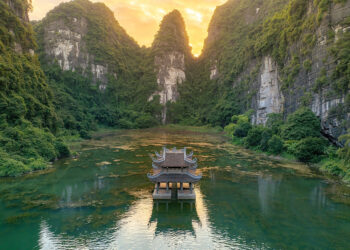
Where: Ninh Binh, North Vietnam
Vietnamese call Trang An the inland Ha Long Bay. The towering limestone karst mountains studded with caves and covered in forest look similar, but rather than sitting over emerald ocean, they stand over huge plains of rice fields and lakes. Temples glisten on their summits. Towns huddle at their feet. The best way to see them is by boat – drifting along the tributaries of the Red River as it passes through the lily-filled flood lands and paddies and cuts into the mountains themselves in series of stalagmite-studded dripping caverns.
At Hang Mua you can climb the summit of one of the peaks for jaw-dropping views. People have lived in Trang An for over 30,000 years, leaving their marks in petroglyphs and cave paintings, and a string of temples, too – 11th century Hoa Lu, tiny Bich Dong at a cave mount and Bai Dinh, one of the largest Buddhist complexes in Southeast Asia.
Citadel of the Ho Dynasty
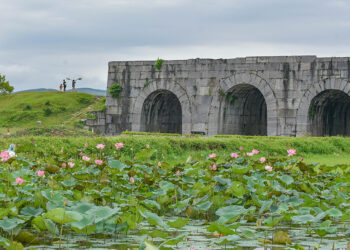
Where: Vĩnh Lộc District, North Vietnam
Today, the old capital city of the Ho Dynasty is little more than a triple arched gateway set in a flat rice fields outside little Vinh Loc town, but look at it on Google Maps and you’ll see the imprint of a huge square of walls and avenues extending over 155 hectares. In the 1400s, the citadel was the royal and administrative centre of an even larger city covering fifty square kilometres – many times larger than contemporaneous London.
Its construction – using large slabs and limestone – was novel in Southeast Asia at the time, and its layout, based on Chinese Feng Shui principles, symbolised power radiating from the royal centre, in harmony with the layout of the landscape. It must have been awe-inspiring in its day, with plush halls and temples laid out on a lush plain between the Ma and Buoi Rivers at the feet of the rolling hills, and it remains one of the top sights in Vietnam.


