
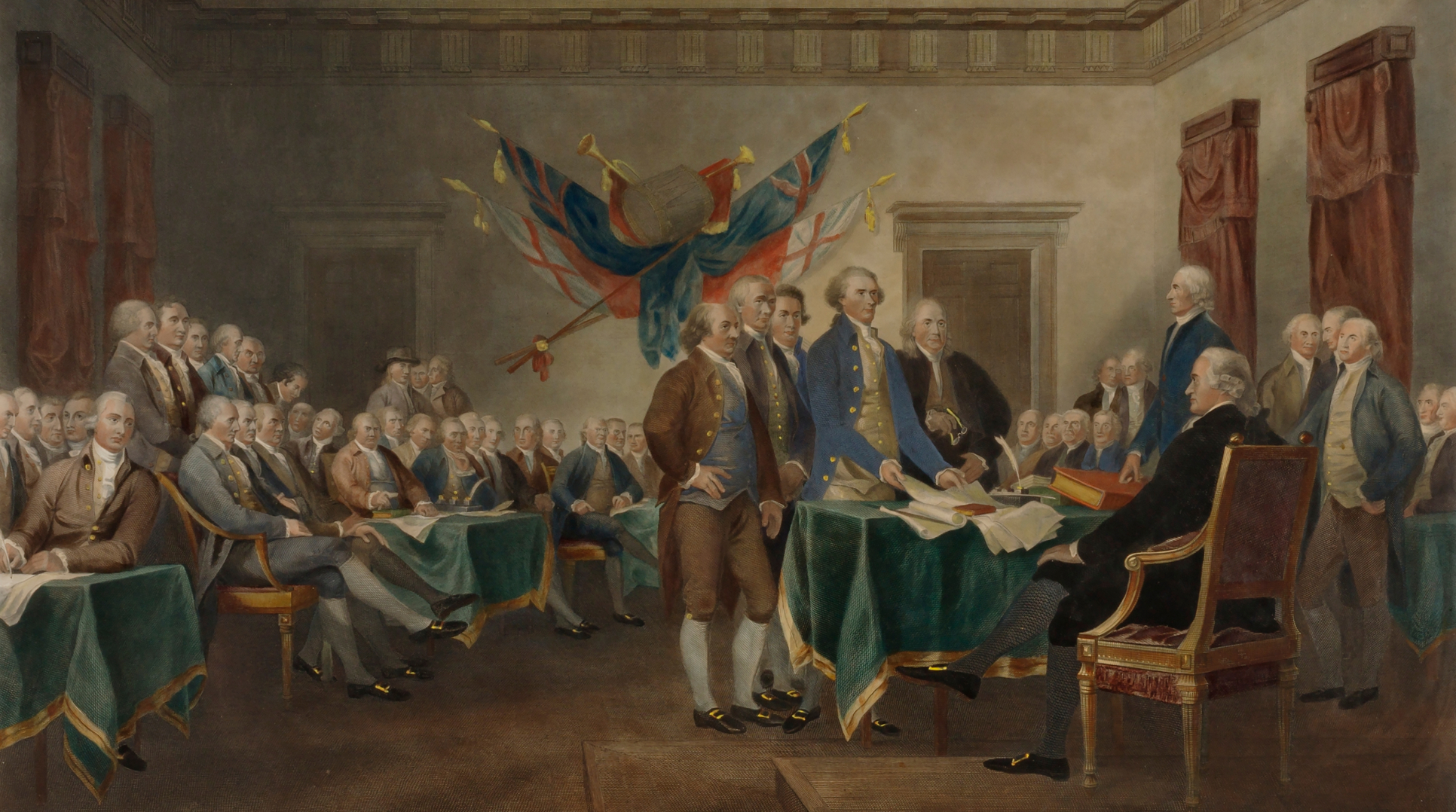
The United States turns 250 in 2026. On 4 July 1776, 56 delegates signed the Declaration of Independence, setting 13 fledgling colonies on the path towards becoming a new nation.
All images from Shutterstock or corresponding articles
The story of the Revolution is one that’s well-told: history books trace the debates of the Founding Fathers and the battles that unfolded from Massachusetts to Virginia.
We read about protests and political unrest as a nascent America sought to wrench itself from Britain. But America’s story stretches far beyond the Revolution itself: backwards to the histories and cultures that long predate 1776 and forwards to the many Americas that emerged afterwards.
With America 25,000, we set out to explore that wider story. Exactly how the first humans reached North America remains shrouded in mystery, with competing theories plotting journeys across ancient land bridges and through coastal waters. Some say the First Peoples came here via the ancient expanse of Beringia, where they may have crossed on foot from Asia into North America during the last Ice Age. Others say they travelled by boat along the Pacific coastline, exploring the continent’s fringes eons before modern borders existed. What these hypotheses all have in common is the idea that this continent’s human history begins far earlier than 1776. Through a growing collection of stories and voices, America 25,000 explores the diverse histories and cultures that unfold around and beyond the nation’s founding moment.
Discover America 25,000

Origins and legacy
America’s diverse Indigenous cultures are sometimes spoken about as though they belong to a distant past, their stories told through collections of dusty artefacts in glass-fronted museum cases and at historic battlefields and archaeological sites. But Native Nations – the communities who were here long before the Founding Fathers put a pen to the Declaration of Independence – continue to mould the modern nation.
The scale and sheer diversity of Indigenous America is often overlooked. There are 574 federally recognised tribes in the United States alone, each with distinct identities and relationships to place, and their own unique stories to tell. Across the continent, Indigenous people are preserving languages, ceremonies and artistic traditions, which take on fresh life with new generations. Diné weavers in the Southwest continue centuries-old textile practices; Tlingit artists carve sculptures connected to the ocean; Natives of Alaska compete in games that echo the subsistence lifestyles of their ancestors; and Blackfeet people finish frybread with cinnamon sugar and Nutella. Meanwhile, stories are challenged, reclaimed and retold through new Indigenous-led cultural centres and festivals, offering visitors the chance to hear Native stories from Native people, at a time when America is poised for reflection.
Sherry Rupert
CEO of the American Indigenous Tourism Association

Did you know...
In Oregon’s high desert, archaeologists uncovered the ‘Fort Rock sandals’, among the oldest known footwear in the world, woven from sagebrush bark and dated to around 9,000-10,000 years ago. Meanwhile, in what’s now New Mexico’s White Sands National Park, fossilised human footprints pressed into ancient lakebed mud have been dated back between 21,000 and 23,000 years.
How Indigenous communities are reclaiming their stories – one cultural centre at a time
The first peoples crossed the Bering land bridge from Siberia, moving southward through ice-free corridors into a wilderness of towering forests, open plains, and winding rivers teeming with fish and game.
Over millennia, these early arrivals diversified into hundreds of distinct nations, each developing rich languages, spiritual traditions, agricultural systems, and trade networks. The Olmec raised stone heads in the jungles of Mesoamerica. The Ancestral Puebloans carved cities into canyon walls. The Haudenosaunee forged democratic confederacies that would later inspire constitutional thinkers an ocean away.
Then came 1492, and the world fractured. European contact unleashed disease, displacement, and conquest on a catastrophic scale. Yet Indigenous cultures endured, adapted, and resisted. Colonial settlements grew into republics, republics grew into industrial powers, and industrial powers stretched satellites into orbit.
America’s full story is not four hundred years old, nor two hundred and fifty. It is twenty-five thousand years deep — a layered, contested, extraordinary human chronicle still being written with every passing generation.
Incredible places to learn about Native American cultures
America’s Indigenous history dates back tens of thousands of years – with many of the stories and traditions we hear about today passed down through generations and preserved in their entirety over recent centuries. Across the States, Indigenous storytelling presents an opportunity to open your mind to how people lived pre-colonisation and how they continue to thrive in the modern era. These are stories of not only cultural riches and knowledge of land – but also of survival.
The Indigenous experiences at the heart of urban Seattle
Seattle carries its Indigenous heritage more visibly than many American cities, starting with its very name. The Emerald City is named for Chief Si’ahl (anglicised as ‘Seattle’), an Indigenous Suquamish and Duwamish leader whose people lived around the inlets and salmon-rich waterways of the Puget Sound, long before Seattle sprouted here in the 1850s.
Solving the mysteries of Mesa Verde, the USA's largest archaeological site
In south-west Colorado lies the largest archaeological preserve in the USA, a series of vast cliff dwellings whose residents ‘vanished’ overnight. But was the answer to their disappearance in plain sight?
How Indigenous Hawaiian tour guides are connecting travellers with the land
“Eala e, ka lā i ka hikina, I ka moana, ka moana hohonu, Pi‘i ka lewa, ka lewa nu‘u, I ka hikina, aia ka lā, e ala e…” Nan Cabatbat stood at the
edge of Haleakalā crater and sang from her stomach. Each note of the traditional Hawaiian chant seemed to take on its own life, echoing across a craggy expanse of chestnut-coloured rock. Tendrils of cloud crept over the landscape, as ethereal as the melody. A small crowd had gathered around us, but there was silence save for the song.
Frontiers of change
Kate Egner
Senior Manager at the American Battlefield Trust
The formation of the United States is often described as an ‘experiment’: a new-born republic built on radical ideas about liberty, self-government and representation, yet rife with contradictions that would continue to surface over the centuries that followed. And America’s founding story did not stop with the Revolution either. Independence may have created a new nation, but the subsequent decades were defined by constant reinvention and debate over what America was and who it was for. From abolitionists and suffragists to labour organisers and civil rights activists, generations of Americans pushed the country to confront the ideals it was founded upon – and plenty still do today.
Many of the places tied to America 250 carry traces of those struggles and contradictions. Battlefields and cobbled colonial streets sit alongside churches that sheltered freedom fighters, while the grand estates of presidents who denounced slavery include quarters where enslaved people once lived and worked. As America rings in 250 years, communities across the country are celebrating the nation’s founding – and also reflecting on the histories that unfolded afterwards and the voices that have long fought to be heard within them.
Barry McNealy
Historian and Master Tour Guide at Birmingham Civil Rights Institute in Alabama
Did you know...
In September 1814, as British forces bombarded Baltimore during the War of 1812, lawyer Francis Scott Key watched anxiously from a ship in the harbour. At dawn, he saw the American flag still flying over Fort McHenry, a sight that inspired him to write a poem: “Defence of Fort M’Henry.” Set to music and retitled “The Star-Spangled Banner,” it would go on to become the United States’ national anthem.
Living history: The untold tales of Virginia's Historic Triangle
Winter held Colonial Williamsburg in an iron grip. It had flayed the leaves from the old Compton Oak on Nicholas Street, and chilled the visitors strolling its streets, their collars turned up against the icy wind. Still, the sky was milky blue over the world’s largest living history museum – a neat matrix of buildings that whisks visitors back to the second half of the 18th century, when the air was thick with revolution.
Marching on: Where to learn about African American history in the US Capital Region
There’s a meme currently going around the internet that says something along the lines of: ‘If you ever wondered what you’d have done during the Civil Rights Movement, you’re doing it now.’
We’re going through a strange time in the US, a backlash of sorts where threats to voting rights are at an all-time high, police violence against African Americans is common and politicians are questioning the ‘educational value’ of teaching Black history and making strides to ban it from classrooms. For many it seems like the USA is losing ground on the gains made by the Civil Rights Movement in the 1960s.
How a Louisville museum is reframing the Revolution
If you’re planning a trip to explore America’s Revolutionary past, you might first look to Boston, where dissent against the British crown gathered early momentum, seeing chests of tea dumped into the harbour in a rollicking act of rebellion. Or perhaps you might head to Philadelphia, where resistance was hotly debated and organised, and where the Declaration of Independence was ultimately signed.
Did you know...
Decades before prospectors flocked west, America’s first gold rush began in the hills around Georgia’s Dahlonega in 1828, when deposits were discovered on lands belonging to the Cherokee Nation. Thousands of miners poured into north Georgia in search of fortune – nearly 20 years before the more famous California Gold Rush.
Following the trails that are retelling America’s story
The first peoples crossed the Bering land bridge from Siberia, moving southward through ice-free corridors into a wilderness of towering forests, open plains, and winding rivers teeming with fish and game.
Over millennia, these early arrivals diversified into hundreds of distinct nations, each developing rich languages, spiritual traditions, agricultural systems, and trade networks. The Olmec raised stone heads in the jungles of Mesoamerica. The Ancestral Puebloans carved cities into canyon walls. The Haudenosaunee forged democratic confederacies that would later inspire constitutional thinkers an ocean away.
Then came 1492, and the world fractured. European contact unleashed disease, displacement, and conquest on a catastrophic scale. Yet Indigenous cultures endured, adapted, and resisted. Colonial settlements grew into republics, republics grew into industrial powers, and industrial powers stretched satellites into orbit.
America’s full story is not four hundred years old, nor two hundred and fifty. It is twenty-five thousand years deep — a layered, contested, extraordinary human chronicle still being written with every passing generation.
Learn about the American Revolution in Boston
Walk the cobbled streets of historic Boston, past old meeting houses, cemeteries and immaculately preserved buildings, and it’s very easy to imagine what Boston was like during the American Revolution.
Learn about the American Revolution in Philadelphia
As the largest city and unofficial capital of the colonies, Philadelphia was the spiritual heart of Revolutionary America. A febrile place of ideas and grievances, it was the spark that lit the gunpowder of revolution, and the city is packed with places fundamental to the birth of the new nation.
Land and spirit
America’s landscapes have long inspired awe. They have moulded entire belief systems, sustained communities for millennia and seeded some of the world’s most ambitious conservation efforts.
In fact, the USA became the birthplace of the national park movement back in 1872, when Yellowstone was established as the world’s first national park: an idea that has now spread to more than 100 countries worldwide. Since the 19th century, a vast network of protected lands has emerged across the US: soaring granite cliffs in Yosemite, ancient rainforests in Olympic, gaping desert canyons, prairie grasslands, rugged coasts and remote islands. Long before the creation of these national parks, Native Nations maintained deep cultural and spiritual connections to America’s natural world – and today vital conversations about stewardship, preservation and access to public lands are coming to the fore.
As America marks 250 years, these landscapes offer another way of understanding the nation – after all, the story of this country was decided as much by its rivers, mountains and ancient trails, as it was by its politics and battlefields. Today the USA’s public lands act as places of recreation and refuge, and also as living cultural landscapes.
Cassidy Jones
Senior Visitation Program Manager at the National Parks Conservation Association
Did you know...
The US is home to the world’s largest dark sky sanctuary: Oregon’s vast Oregon Outback International Dark Sky Sanctuary, where minimal light pollution reveals some of the clearest night skies on the planet.
The most uplifting conservation stories shaping America right now
The first peoples crossed the Bering land bridge from Siberia, moving southward through ice-free corridors into a wilderness of towering forests, open plains, and winding rivers teeming with fish and game.
Over millennia, these early arrivals diversified into hundreds of distinct nations, each developing rich languages, spiritual traditions, agricultural systems, and trade networks. The Olmec raised stone heads in the jungles of Mesoamerica. The Ancestral Puebloans carved cities into canyon walls. The Haudenosaunee forged democratic confederacies that would later inspire constitutional thinkers an ocean away.
Then came 1492, and the world fractured. European contact unleashed disease, displacement, and conquest on a catastrophic scale. Yet Indigenous cultures endured, adapted, and resisted. Colonial settlements grew into republics, republics grew into industrial powers, and industrial powers stretched satellites into orbit.
America’s full story is not four hundred years old, nor two hundred and fifty. It is twenty-five thousand years deep — a layered, contested, extraordinary human chronicle still being written with every passing generation.
US National Parks: what you need to know about visiting
“The best idea we ever had.” That’s how American writer and environmentalist Wallace Stegner described the USA’s national park system back in 1983. Decades on, the statement rings true.
Since 1916, the National Park Service (NPS) has protected America’s greatest wildernesses, from the titanic peaks of the Rockies to the kaleidoscopic hot springs of Yellowstone. Skyscraping sequoias, cacti-stitched deserts, mangrove-filled wetlands, rocky coastlines, waterfalls, lakes, badlands – the mind-boggling diversity of the USA’s landscapes is on display across the country’s national park sites.
Could this important Indigenous site be Georgia’s first national park?
Trimmed with sweetgum trees and wrapped in velvety grass, the land gently rose and fell all around me as I strolled. Up ahead, a paved path led to a neat, conical mound that spiked towards the sky. Behind me, a tour group hummed and chattered.
“For me, when I come here, it’s like being at grandma’s house,” said Tracie Revis, who was showing me across the swollen terrain of Ocmulgee Mounds National Historical Park. “Everything changed when I smelled a root here that we still use in our traditional medicines today. I thought: ‘What would it look like to live back in the homeland?’”
The living nation
No single story can fully capture America. Across centuries, successive waves of newcomers have arrived on its shores – some arriving as part of colonial expansion, some bound by slavery, others hoping for new opportunities or better lives away from homelands riddled with conflict. What they all have in common is that they brought with them languages, traditions, recipes and ideas that have continually remade the nation. Their stories intertwine with those of the hundreds of Indigenous Nations whose experiences on this continent predate the United States itself.
Together they created one of the most culturally diverse places on the planet and that can be felt everywhere. It plays out in the jazz clubs of New Orleans, through the mural-covered neighbourhoods of Los Angeles, the Indigenous art markets of the Southwest and the mom-and-pop restaurants that serve up dishes from every corner of the globe. Writers, musicians, chefs, artists and entrepreneurs draw on a multitude of heritages as they create. In mushrooming city districts and quaint rural towns, countless traditions coexist and overlap. As the United States turns 250, its diversity remains one of its enduring strengths, something that continues to evolve centuries after the ink dried on the nation’s founding documents.
“Barrio Logan is a powerful symbol of Chicano activism and creative expression. This neighbourhood was literally split in half… but instead of disappearing, the community fought back and transformed their trauma into art.”
Claudia Rodríguez-Biezunski
Fashion designer and owner of Sew Loka
San Diego, California
“New York City is such a unique place for LGBTQ+ history – ours shaped history around the country and the globe. That history is life-changing and life-saving.”
Michael Venturiello
Founder and owner of Christopher Street Tours
New York City
“Each quilt I make is like a child being born – I give it a name when I finish it. It’s a gift from God. I don’t have any other way to explain it. He gave me the gift to create.”
Mary Ann Pettway
Quilter and manager of the Gee’s Bend Quilters Collective
Gee’s Bend, Alabama
“What makes Gullah Geechee culture so special is its authenticity, resilience and the richness of its African roots – passed down through generations despite centuries of displacement, oppression and erasure.”
Lola Campbell
Tour guide
Hilton Head Island, South Carolina
“Unfortunately, the Keyauwee Tribe has not survived here in Davidson County, but we are able to remind our customers that all the lands were once inhabited by Native peoples.”
Victoria Lewis
Manager at Native Vines Winery
Lexington, North Carolina
“The spirit of New Orleans is rich in community and resilience, having often had to rebuild after hurricanes. These are the same qualities that anchor the Vietnamese community, which has had to rebuild from war.”
Chef Anh Luu
Owner of Xanh
New Orleans, Louisiana
How the US is marking America 250
Events across the USA celebrating the 25,000 years of American history