
British Break: Lake District, Cumbria
The region so beloved of poets and hikers is also studded with Neolithic and Bronze Age stone circles built by our ancient forebears. Martin Symington loses himself in legend.
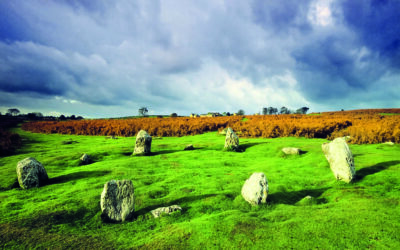
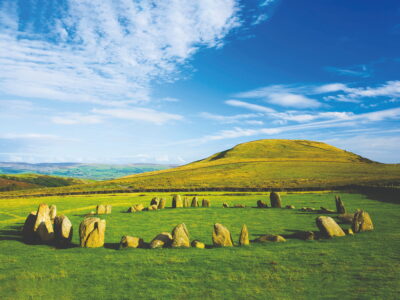
The stones of Castlerigg appeared out of the morning mist like a ring of wraiths enacting a solemn ritual. About 40 of them – some small, others 2m-high giants – formed a silent circle amid the Lakeland fells. Could they have been a herd of enchanted, eternally milk-giving cows tricked by a jealous witch? It was soon after dawn, and I was trudging across a dew-dampened field towards this prehistoric monument. My head was swimming with the legends and whimsical stories I’d read about the origins of stone circles built in Britain up to 5,000 years ago. Yet none of them felt outlandish in the witching hour.
The horizon above Skiddaw’s hump was streaked with shafts of light as I gazed at the stones, their faces of mottled grey hung with sinister lichen beards. The Lake District is often viewed through the eyes of Wordsworth and Coleridge. Curiously, the Lakeland Poets gave scant attention to the prehistoric sites strewn across Cumbria, including around 50 stone circles. I had come to the region with some of these in my sights. In particular, I aimed to explore the myths and legends surrounding the rings of Castlerigg, Swinside, and Long Meg and her Daughters – all in magical locations and accessible to all, free from turnstiles or any form of officialdom.

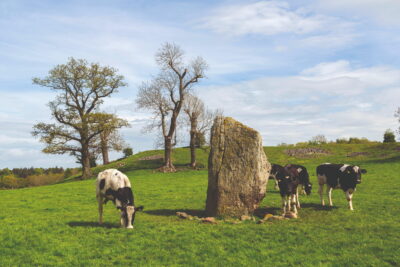
The second of my lithic trinity is overseen by Long Meg – reputedly once a witch, petrified for dancing on the sabbath, now a pinkish, 4m-high stone etched with spirals and what are thought to be fertility symbols. The bulky boulders arranged in a wide oval were her offspring (or lovers, according to some). Intriguingly, this circle is aligned with the solstices. To find the farthest flung and least visited of the three circles, I drove south-west to a tract of farmland that lay about 2.5km from the nearest significant road.
With fells blazing green and gold all around, the 55 close-packed stones of Swinside appeared in a field, alone save for a sprinkling of sheep. A pair of portal boulders is believed to have been placed in alignment with the midwinter sunrise. Less scientific is the legend that, during the construction of a church in the Middle Ages, the Devil pulled down the stones at night and arranged them in a circle. The remains of that church are said to lie beneath the circle, hence Swinside’s alternative name: ‘Sunkenkirk’. It was one more fantastical thing to ponder, along with the witches and astronomical wonders.
Ask a local
“One of the glorious things about living in the Cumbrian fells is that, wherever you look, there are monuments left by Neolithic people. It is all prehistory, so we remain in the dark about what life was like in their Lake District. Were the circles of stone where they gathered places of community, authority or worship? We do not know, but we can feel their mysterious power.”
Joanna Dancer, English Heritage volunteer
DAY 1
Start in the lively market town of Keswick. After coffee and a slice of honeycomb crunch traybake at Byson’s on Main Street, pop into Keswick Museum to admire axeheads and other local Neolithic finds. If you have time, take a walk east to Castlerigg Stone Circle, revelling in vistas of Skiddaw, Blencathra and the Helvellyn range. Complete a round tramp via the Keswick Railway Path. The A66 east from Keswick may follow the route of an ancient trackway running some 25km to the circular Neolithic earthwork of Mayburgh Henge. Climb the bank, walk around the circumference and continue 400m to another earthwork known as King Arthur’s Round Table. The site dates from 2000 BC and, according to legend, was later used as a jousting area by the very same mythical monarch.
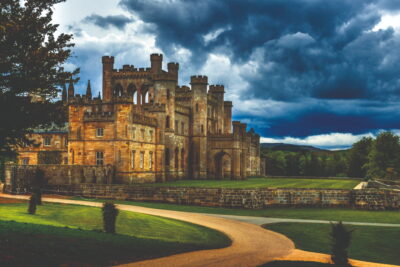
Nose around the ruins and gardens of Lowther Castle, a little to the south. Then drive on to the car park for Long Meg and her Daughters, and walk to the standing stone and circle. If you’re heading back towards Keswick and feel like splashing out, consider stopping for dinner at the Michelin-starred Cottage in the Wood.
DAY 2
The southern Lake District feels distinct from the high fells and rugged crags of the region’s north and central areas. Winding south on the A591, there’s one major cliché that demands to be ticked off: pay homage to William and Dorothy Wordsworth at the poets’ Dove Cottage in Grasmere. If it’s brunch o’clock, try Matilde’s Café in Heaton Cooper Studio, which displays Lakeland-inspired art. At Ambleside, veer south-west along the A593 past Coniston Water and towards your next target: Swinside. Park in a layby off the A595 at Broadgate and walk 2.5km north along a farm track to the near-perfect ring.
You’re not far from the beaches, bays and salt marshes of the Cumbria Coast and the Furness Peninsula, just outside the National Park. Climb the signposted path to Birkrigg Stone Circle, a pair of concentric Bronze Age rings overlooking Morecambe Bay. Finally, indulge at The Lake District Lobster and Seafood Company in Ulverston.
4 SIDE TRIPS
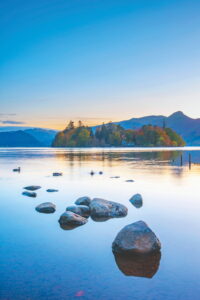
LOOK for ospreys (Apr–Sep) on and above the forested shores of Bassenthwaite Lake. These fish-hunting birds of prey, with wings spanning up to 1.7m, went extinct in England in the mid-19th century but returned at the turn of this century. With patience, you might just be able to spot one from the Dodd Wood viewpoint near Keswick.
FLOAT back in time aboard the National Trust’s glorious Steam Yacht Gondola, enjoying the historical commentary as you glide the tranquil expanse of Coniston Water. This Victorian-era passenger steamer has been painstakingly restored to its former glory, its engine now fuelled by waste wood rather than coal.
PEDAL tracks through Grizedale Forest, between Coniston and Windermere, on rented mountain bikes. Trails snaking through the red- deer-foraged woodland are flanked by more than 40 sculptures by artists from around the world.
MARVEL at the thunderous Aira Force waterfall, cascading 20m in Gowbarrow Park above Ullswater. Drink in the spectacle from a pair of footbridges – one above the falls, the other below – at the end of a lovely woodland trail.
The author’s trip was supported by Visit Lake District.
Getting there: Oxenholme and Carlisle are on the West Coast Main Line, served by trains from London Euston, Birmingham, Manchester, Glasgow and Edinburgh. The Lakes branch line runs from Oxenholme to Kendal and Windermere. However, with Castlerigg in central Cumbria, Long Meg in the north and Swinside to the south, there is no practical alternative to having your own wheels.
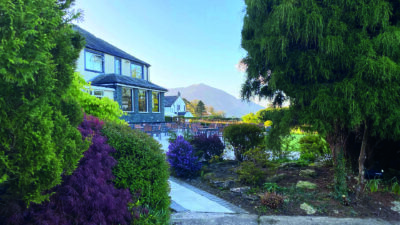
Stay at: The Lake District Castle Inn, near Keswick and Castlerigg in the north of the National Park, is within walking distance of Bassenthwaite Lake National Nature Reserve. The hotel has an indoor pool and offers al-fresco dining in a delightful garden. B&B doubles from £119 per night.


