WANDERLUST NEWS
Expedition cruise ship breaks world record Expedition cruise ship breaks world record
Words: Mark Stratton
On the morning of 25 February 2026, Aurora Expeditions’ newly launched expedition cruise ship MV Douglas Mawson, named after the legendary Australian geologist and explorer, reached 78º 44.405’ S in the Bay of Whales, deep in the eastern corner of the Ross Sea, achieving the southernmost voyage in history.
By doing so, it broke a record held since 2022 by the US Coast Guard icebreaker USCG Polar Star. That this occurred on a passenger expedition ship is not as surprising as it might seem, as another previous record holder was the Spirit of Enderby, which reached 78°44.008´S in 2017.
Conditions played their part. The Ross Sea is infamously difficult to navigate, as it is covered in thick sea ice for most of the year. There is only a short window of opportunity (Jan–Feb) for ships to traverse it.
“Compared to the Antarctic Peninsula, where most ships go, the Ross Sea is more hardcore. The distances are longer and ships fewer, so you are on your own,” says expedition leader Howard Whelan, who had never reached the Bay of Whales before during a 30-year career in polar exploration.
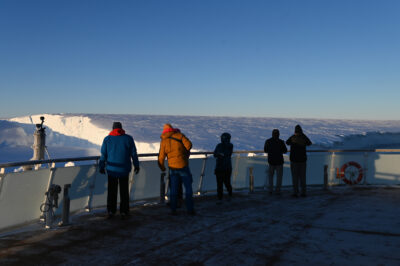
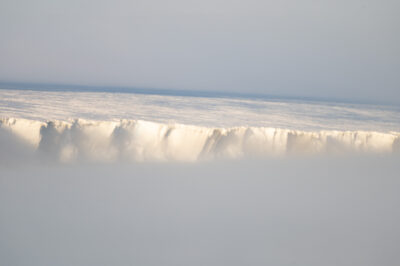
For two days, the ship traversed eastwards, skirting the Ross Sea’s frozen iceshelf, a barrier wall of ice hundreds of kilometres long and between 15m and 30m high. Few ships, particularly non-icebreaker passenger ships like this, visit here each summer season. And those who do may be thwarted by heavy sea ice locked together by tides and winds.
Despite it being -18ºC outside, conditions proved favourable.
“It’s one of those rare moments when the weather and ice came together to allow us passage in the Bay of Whales, and Captain Jorge Ferdinez and his bridge team had the navigational skills to get across the line,” continued Whelan.
The moment the record was broken was unforgettable. “That’s the record,” shouted Ashley Perrin, assistant expedition-leader, on the bridge bow, coordinating with the MV Douglas Mawson’s skipper.
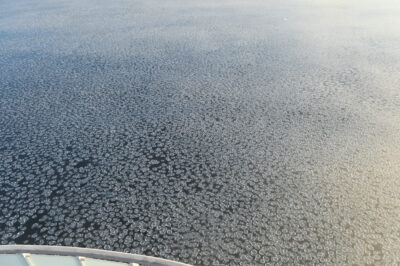
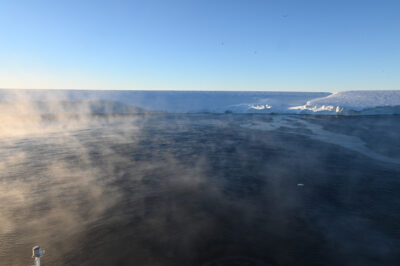
Beyond the ship, platelets called pancake ice had locked together to form a transparent patterned sheen on the sea surface. Sea smoke, formed when super cold air moves across relatively warm water, diffused the near perpetual summer sunshine into an opaque light. And in front of us a huddle of emperor penguins watched curiously from their icy ridge.

The Bay of Whales is forever immortalised by a more famous vessel, the Fram, which came here to establish the base Framheim, used by the explorer Roald Amundsen when he successfully reached the South Pole in 1911. At some stage in the late 1950s, the base broke away when the iceshelf fractured, and now it no longer exists.
A two-week voyage now lies ahead of the MV Douglas Mawson, which is halfway through a 6,000 nautical mile transit from Dunedin in New Zealand to Ushuaia in southern Argentina, skirting Antarctica from east to west.
Sea ice remains a daily challenge, and Whelan explains that fuel consumption must be balanced against the ship working its way either through or around the ice on a long voyage like this.
“It’s like climbing a mountain. You get to the top, but you’ve got to get down again,” he says.
You can read Mark Stratton’s full account of his epic Transantarctic sea journey in a forthcoming issue of Wanderlust.